
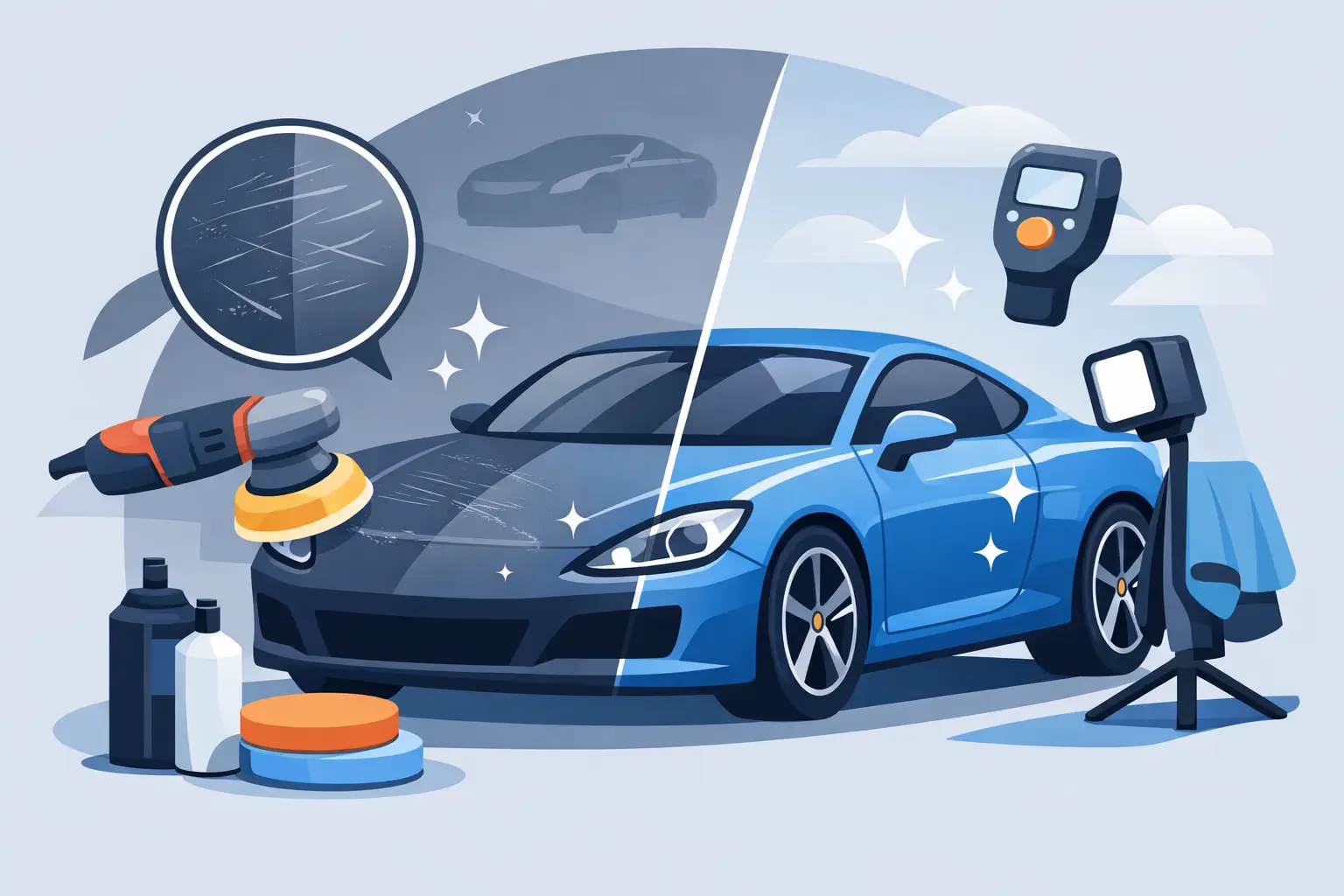
A clean car can still look tired when sunlight exposes swirl marks, haze, water spots, and light scratches across the paint. This complete guide to paint correction explains what professional correction actually does, what it cannot do, and why the process matters for drivers who want a true showroom-level finish instead of a temporary shine.
What Paint Correction Really Means
Paint correction is the professional process of leveling defects in a vehicle’s clear coat to improve gloss, clarity, and reflection. Modern automotive paint usually has a colored base coat protected by a transparent clear coat. Many visible flaws sit in or affect that outer clear layer.
A detailer uses specialized machines, pads, compounds, and polishes to carefully reduce the appearance of these defects. The goal is not to cover them with a glaze or wax that fades after a few washes. It is to refine the paint surface so light reflects evenly again.
The difference is easy to see on a dark-colored vehicle parked in Los Angeles sun. Swirls that made the paint look gray or cloudy are reduced, reflections sharpen, and the color appears deeper. On white, silver, or light-colored vehicles, the change may be more subtle, but the finish can still look cleaner, brighter, and more uniform.
What Paint Correction Can Remove
Most cars develop paint defects through normal use. Improper washing, automated car washes, dirty towels, dust, road grime, and repeated drying can all leave fine marks behind. Professional paint correction is designed to address the defects that make paint lose its crisp, glossy appearance.
It can significantly improve light swirl marks, fine scratches, wash marring, oxidation, dullness, light etching from water spots, and haze left by poor polishing. It can also improve uneven-looking paint on vehicles that have been neglected or repeatedly run through brush-style washes.
Paint correction has limits. A scratch that catches a fingernail may be too deep to safely remove. Rock chips, deep gouges, peeling clear coat, cracked paint, and damage that has reached the color coat require touch-up, repainting, or bodywork. A reputable detailer should explain those limits before work begins rather than promising perfection where it is not possible.
Why a Wash and Wax Is Not the Same Service
A wash and wax can make a vehicle look better quickly, but it does not correct the paint. Waxes, sealants, and some dealership or car wash products may add gloss and temporarily fill very fine imperfections. Once that product wears away, the swirls and haze remain.
Paint correction takes more time because the detailer has to inspect, clean, decontaminate, test the paint, choose the right pad and polish combination, and work each panel with controlled technique. The preparation is just as important as the polishing. Polishing dirty or contaminated paint can create more damage, which is the opposite of the result you want.
For owners who care about lasting visual improvement, correction is the step that creates the foundation. Protection comes after the paint has been properly refined.
The Complete Guide to Paint Correction Process
Every vehicle should be assessed individually. Paint condition, vehicle age, color, previous repairs, clear-coat thickness, and customer expectations all affect the recommended approach. A quality service is not one-size-fits-all.
Inspection and Safe Decontamination
The process begins with a detailed inspection under proper lighting. This reveals defects that ordinary daylight can hide, including circular swirls, random scratches, and buffer trails from prior work. A paint thickness gauge may also be used when appropriate, especially on vehicles with unknown history or possible repaint work.
Next comes a thorough hand wash using surface-safe methods. The paint is then decontaminated to remove bonded fallout, brake dust, sap, tar, and other particles that washing alone cannot remove. Skipping this stage can interfere with polishing and leave the finish feeling rough even after it looks shiny.
Test Spot and Paint Refinement
Before correcting the entire vehicle, a professional creates a test spot on a small section. This allows the detailer to find the least aggressive method that delivers a meaningful improvement. That balance matters. More aggressive compounding may remove deeper defects, but it also removes more clear coat.
Depending on the paint condition, the service may involve a single-stage polish or a multi-stage correction. A single-stage polish is often a strong choice for newer vehicles with light swirls or for customers who want a noticeable improvement without pursuing near-perfect paint. It can restore gloss efficiently while preserving clear coat.
A multi-stage correction typically starts with a cutting step to reduce more substantial defects, followed by a finishing polish that refines the surface and maximizes clarity. This is often the right choice for darker paint, heavily swirled vehicles, or owners who want a more dramatic transformation. It takes longer and costs more because the process requires additional labor, inspection, and precision.
Panel Wipe and Protection
After polishing, the surface is wiped down to remove polishing oils. This is the moment when the real condition of the paint becomes clear. A proper inspection confirms that defects have been reduced rather than hidden.
The final step is protection. A quality sealant, wax, or ceramic coating helps preserve the corrected finish and makes routine maintenance easier. For drivers who want long-term protection from sun exposure, contaminants, and frequent washing, ceramic coating is often the natural next step. It is not a force field against scratches, but it can add durable protection, enhance gloss, and reduce how strongly dirt and water cling to the surface.
How Much Correction Does Your Car Need?
The right level depends on the vehicle and the owner’s priorities. A daily driver that spends time in parking structures, school drop-off lines, or beach traffic may not need every isolated mark removed. A sensible correction that restores gloss and reduces the most visible defects can provide excellent value.
A newer luxury vehicle, collector car, or dark-colored vehicle may justify more extensive refinement. The same is true before applying a ceramic coating, because the coating will preserve the appearance of the paint underneath it. If the paint has haze and swirls before coating, those defects will still be there after coating.
It also depends on paint thickness and condition. Clear coat is not unlimited, and responsible correction always prioritizes the long-term health of the finish. The best result is not necessarily 100 percent defect removal. It is the best safe improvement for that specific vehicle.
How Long Does Paint Correction Take?
A light polishing service may take several hours, while a multi-stage correction can take a full day or longer. Larger vehicles, heavily damaged finishes, intricate body lines, and dark paint often require more time. Mobile service adds convenience, but the work still demands the same careful preparation, controlled environment, and attention to detail as shop-based work.
For customers in Los Angeles, Santa Monica, Brentwood, or West Los Angeles, having professional paint correction performed at home or work can save a trip without lowering the standard of care. The key is allowing enough time for the detailer to do the job properly. Fast promises and bargain pricing often mean skipped preparation or temporary fillers rather than genuine refinement.
Keeping Corrected Paint Looking Its Best
Paint correction improves the finish, but maintenance protects the investment. Avoid automated brush washes, which are a common source of fresh swirls. Use clean microfiber towels, quality wash products, and safe hand-washing techniques. Never wipe dusty paint dry, and address bird droppings, tree sap, and hard-water spots quickly before they have time to etch the surface.
If a ceramic coating has been applied, follow the care guidance provided by your detailer. Coatings still need regular washing. They make maintenance easier, but they do not eliminate it.
A corrected finish changes more than how a vehicle photographs. It makes every walk back to the car feel better. When you are ready for that kind of visible improvement, Drip N Shine can assess your paint honestly and recommend the level of correction that makes sense for your vehicle and how you use it.